
Hooks National Book Award
Celebrating the Civil Rights Movement and Its Legacy
The Hooks Institute National Book Award celebrates the Civil Rights Movement and its legacy.
Since 2010, the Hooks Institute has presented its National Book Award to non-fiction books that best further our understanding of the Civil Rights Movement and its legacy. Previous winners include works focusing on civil rights and social change issues, leaders, policies, and more.
The Hooks Institute National Book Award bridges past and present civil rights movements and highlights the struggles that grant us the freedoms and rights we enjoy today. With over 500 nominations received since the beginning of the program, these scholarly works inform our knowledge of the past while providing a blueprint to continue the fight for a just and equal society.
2025 Finalists Announced!

The Hooks Institute is proud to announce the 2025 Hooks Institute National Book Award
finalists:
Freedom Season: How 1963 Transformed America’s Civil Rights Revolution, by Peniel E. Joseph (Basic Books)
In Freedom Season: How 1963 Transformed America’s Civil Rights Revolution, acclaimed historian Peniel E. Joseph offers a stirring narrative history of 1963,
marking it as the defining year of the Black freedom struggle—a year when America
faced a deluge of political strife and violence and emerged transformed.
Nineteen sixty-three opened with the centenary of the Emancipation Proclamation and
ended with America in a state of mourning. The months in between brought waves of
racial terror, mass protest, and police repression that shocked the world, inspired
radicals and reformers, and forced the hands of moderate legislators. By year’s end
the murders of John F. Kennedy, Medgar Evers, and four Black girls at a church in
Alabama left the nation determined to imagine a new way forward. Alongside the stories
of historical giants like James Baldwin and Martin Luther King Jr., Joseph uplifts
the perspectives of less celebrated leaders like playwright Lorraine Hansberry and
activist Gloria Richardson.
Over one heartbreakingly tumultuous year, America unraveled and remade itself as the
world looked on. Freedom Season shows how the upheavals of 1963 planted the seeds for watershed civil rights legislation
and renewed hope in the promise and possibility of freedom.
House of Diggs: The Rise and Fall of America’s Most Consequential Black Congressman, Charles C. Diggs Jr., by Marion Orr (The University of North Carolina Press)
A Black congressman’s fight for civil rights, from Emmett Till to anti-apartheid activism
At the height of the civil rights movement, Charles C. Diggs Jr. (1922–1998) was the
consummate power broker. In a political career spanning 1951 to 1980, Diggs, Michigan’s
first Black member of Congress, was the only federal official to attend the trial
of Emmett Till’s killers, worked behind the scenes with Martin Luther King Jr., and
founded the Congressional Black Caucus. He was also the chief architect of legislation
that restored home rule to Washington, DC, and almost single-handedly ignited the
American anti-apartheid movement in the 1960s. Drawing on extensive archival research,
including Diggs’s rarely seen personal papers, FBI documents, and original interviews
with family members and political associates, political scientist Marion Orr reveals
that Diggs practiced a politics of strategic moderation. Orr argues that this quiet
approach was more effective than the militant race politics practiced by Adam Clayton
Powell and more appealing than the conservative Chicago-style approach of William
Dawson—two of Diggs’s better-known Black contemporaries.
Vividly written and deeply researched, House of Diggs is the first biography of Congressman Charles C. Diggs Jr., one of the most consequential
Black federal legislators in US history. Congressman Diggs was a legislative lion
whose unfortunate downfall punctuated his distinguished career and pushed him and
his historic accomplishments out of sight. Now, for the first time, House of Diggs restores him to his much-deserved place in the history of American politics.
New Prize for These Eyes: The Rise of America’s Second Civil Rights Movement, by Juan Williams (Simon & Schuster)
With “arresting prose and keen insights” (Donna Brazile, New York Times bestselling author of Hacks), bestselling author Juan Williams turns his attention to the rise of a new 21st-century
civil rights movement in this highly anticipated follow-up to Eyes on the Prize.
More than a century of civil rights activism reached a mountaintop with the arrival
of a Black man in the Oval Office. But hopes for a unified, post-racial America were
deflated when Barack Obama’s presidency met with furious opposition. A white, right-wing
backlash was brewing, and a volcanic new movement—a second civil rights movement—began
to erupt.
In New Prize for These Eyes: The Rise of America's Second Civil Rights Movement, award-winning author Juan Williams shines a light on this historic, new movement.
Who are its heroes? Where is it headed? What fires, furies, and frustrations distinguish
it from its predecessor?
In the 20th century, Black activists and their white allies called for equal rights
and an end to segregation. They appealed to the Declaration of Independence’s defiant
assertion that “all men are created equal.” They prioritized legal battles in the
courtroom and legislative victories in Congress. Today’s movement is dealing with
new realities. Demographic changes have placed progressive whites in a new role among
the largest, youngest population of Blacks, Hispanics, and Asians in the nation’s
history. The new generation is social media savvy, and they have an agenda fueled
by discontent with systemic racism and the persistent scourge of police brutality.
Today’s activists are making history in a new economic and cultural landscape, and
they are using a new set of tools and strategies to do so.
Williams brilliantly traces the arc of this new civil rights era, from Obama to Charlottesville
to January 6th and a Confederate flag in the Capitol. An essential read for activists,
historians, and anyone passionate about America’s future, New Prize for These Eyes is more than a recounting of history. It is a forward-looking call to action, urging
Americans to get in touch with the progress made and hurdles yet to be overcome.
Spell Freedom: The Underground Schools That Built the Civil Rights Movement, by Elaine Weiss (Simon & Schuster)
The acclaimed author of the “stirring, definitive, and engrossing” (NPR) The Woman’s Hour returns with the story of four activists whose audacious plan to restore voting rights
to Black Americans laid the groundwork for the Civil Rights Movement.
In the summer of 1954, educator Septima Clark and small businessman Esau Jenkins traveled
to rural Tennessee’s Highlander Folk School, an interracial training center for social
change founded by Myles Horton, a white southerner with roots in the labor movement.
There, the trio united behind a shared mission: preparing Black southerners to pass
the daunting Jim Crow era voter registration literacy tests that were designed to
disenfranchise them.
Risking their lives and livelihoods, they created the underground Citizenship Schools
project, preparing Black southerners to pass the voter registration literacy tests
and have a voice in their nation’s democracy. By the time the Voting Rights Act was
signed into law in 1965, over nine hundred citizenship school classes had been established—often
in secret locations—across the south, quietly educating tens of thousands of Black
citizens to read and write, demand their civil rights, and vote. The program nurtured
a generation of activists—many of them women—trained in community organizing, political
action, and tactics of resistance, who became the grassroots foundation of the Civil
Rights Movement.
In the vein of Hidden Figures and Devil in the Grove, Spell Freedom: Spell Freedom: The Underground Schools that Built the Civil Rights
Movement is the exhilarating story of ordinary citizens confronting injustice with courage
and creativity, offering a revealing narrative “that illuminates not only the past
but also a path forward” (Jonathan Eig, Pulitzer Prize winner).
Queen Mother: Black Nationalism, Reparations, and the Untold Story of Audley Moore, by Ashley D. Farme (Pantheon Books)
From an award-winning historian of Black radical politics comes the definitive biography of Audley Moore—mother of modern Black Nationalism and trailblazer in the fight for reparations.
In the world of Black radical politics, the name Audley Moore commands unquestioned
respect. Across the nine decades of her life, Queen Mother Moore distinguished herself
as a leading progenitor of Black Nationalism, the founder of the modern reparations
movement, and, from her Philadelphia and Harlem homes, a mentor to some of America’s
most influential Black activists.
And yet, she is far less remembered than many of her peers and protégés—Marcus Garvey,
Malcolm X, and Muhammad Ahmad, to name just a few—and the ephemera of her life are
either lost or plundered. In Queen Mother: Black Nationalism, Reparations, and the Untold Story of Audley Moore, celebrated writer and historian Ashley D. Farmer restores Moore’s faded portrait,
delivering the first ever definitive account of her life and enduring legacy.
Deeply researched and richly detailed, Queen Mother is more than just the biography of an American icon. It’s a narrative history of
20th-century Black radicalism, told through the lens of the woman whose grit and determination
sustained the movement.
________________________________________________________________________________________
Meet the 2025 Finalists!

Peniel E. Joseph is the Barbara Jordan Chair in Ethics and Political Values, founding director of the Center for the Study of Race and Democracy at the LBJ School of Public Affairs, and distinguished service leadership professor and professor of history at the University of Texas at Austin. He is the author and editor of eight award-winning books on African American history, including The Third Reconstruction and The Sword and the Shield. He lives in Austin, Texas.

Marion Orr is a political scientist and the inaugural Frederick Lippitt Professor of Public Policy at Brown University. Professor Orr's expertise is in the area of American politics. He specializes in urban politics, race and ethnic politics, and Black politics. An award-winning author, his work includes Black Social Capital: The Politics of School Reform in Baltimore and The Color of School Reform: Race, Politics and the Challenge of Urban Education. In 2025, he published House of Diggs: The Rise and Fall of America’s Most Consequential Black Congressman, Charles C. Diggs, Jr., the first biography of Michigan’s first Black congressman. Orr was awarded the Biographers International Organization’s Francis “Frank” Rollin Fellowship for his work on Congressman Diggs. Professor Orr has also held research fellowships at the Brookings Institution, University of California, Berkeley, and the Ford Foundation. A native of Savannah, Georgia, he earned his B.A. degree in political science from Savannah State College, M.A. in political science from Atlanta University (now Clark-Atlanta University), and a Ph.D. in Government and Politics from the University of Maryland, College Park.

Juan Williams is a prizewinning journalist and historian. He is the author of the bestselling civil rights history Eyes on the Prize: America’s Civil Rights Years 1954–1965, which accompanied the PBS series of the same name. He also wrote the landmark biography of the first African American on the Supreme Court,Thurgood Marshall: American Revolutionary, as well as the New York Times bestsellers Enough and Muzzled: The Assault on Honest Debate. Williams worked for The Washington Post as a celebrated national political correspondent, White House correspondent, and editorial writer. His NPR talk show took ratings to a new high. He has written for The New York Times, The Wall Street Journal, The New Yorker, The Atlantic, and Ebony. He is currently senior political analyst for Fox News Channel and a columnist for The Hill.

Elaine Weiss is a journalist and author of books of narrative history. Her book on the women's suffrage movement, The Woman's Hour: The Great Fight to Win the Vote was a GoodReads Readers' Choice Award winner, short-listed for the 2019 Chautauqua Prize, and received the American Bar Association's highest honor, the 2019 Silver Gavel Award. Her newest book, Spell Freedom: The Underground Schools that Built the Civil Rights Movement has won high praise from scholars and readers alike, described as "a beautifully crafted and dramatic tale" told with "elegant writing, masterful storytelling, and prodigious research." Spell Freedom was long-listed for the Carnegie Medal for Excellence in nonfiction books, awarded by the American Library Association, and was selected by Amazon's editors as one of the best history books of 2025. Weiss is also a popular speaker and media commentator, and served as historical consultant to the Tony-award winning Broadway musical, SUFFS. She lives in Baltimore.

Ashley D. Farmer is a historian of Black women's history, intellectual history, and radical politics. She is currently an Associate Professor in the Departments of History and African and African Diaspora Studies at the University of Texas at Austin. She is the author of Remaking Black Power: How Black Women Transformed an Era (UNC Press) and Queen Mother: Black Nationalism, Reparations, and the Untold Story of Audley Moore (Pantheon). Farmer's scholarship has appeared in numerous venues, includingThe Black Scholar andThe Journal of African American History. Her research has also been featured in several popular outlets, including Harper's Bazaar, NPR, and Teen Vogue. Numerous schools and foundations, including the Radcliffe Institute for Advanced Study at Harvard University, the National Endowment for the Humanities, and the Whiting Foundation, have supported her research. Farmer earned a BA from Spelman College, an MA in History, and a PhD in African American Studies from Harvard University.
________________________________________________________________________________________
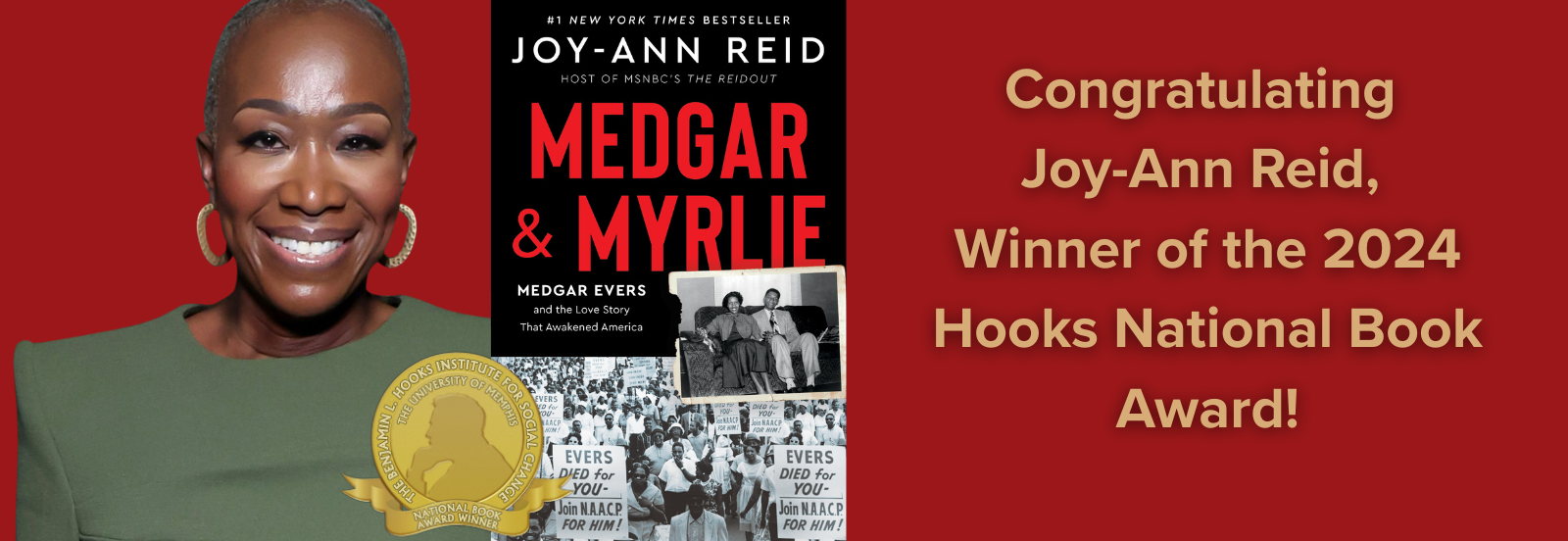
2024 Hooks Institute National Book Award Winner
"Medgar and Myrlie: Medgar Evers and the Love Story That Awakened America" by Joy-Ann Reid (Mariner Books)
Contact
For questions or comments: Please contact Paola Cavallari, Hooks Institute National Book Award Coordinator, at the Hooks Institute, at 901-678-3974 or via email at pcvllari@memphis.edu
About the Hooks Institute
The Benjamin L. Hooks Institute implements its mission of teaching, studying and promoting civil rights and social change through research, education and direct intervention programs. Institute programs include community outreach; funding faculty research initiatives on community issues; implementing community service projects; hosting conferences, symposiums and lectures; and promoting local and national scholarship on civil and human rights. The Hooks Institute is an interdisciplinary center at the University of Memphis. Contributed revenue for the Hooks Institute, including funding from individuals, corporations and foundations, is administered through the University of Memphis Foundation, a 501(c)(3) organization.
Past National Book Award Recipients
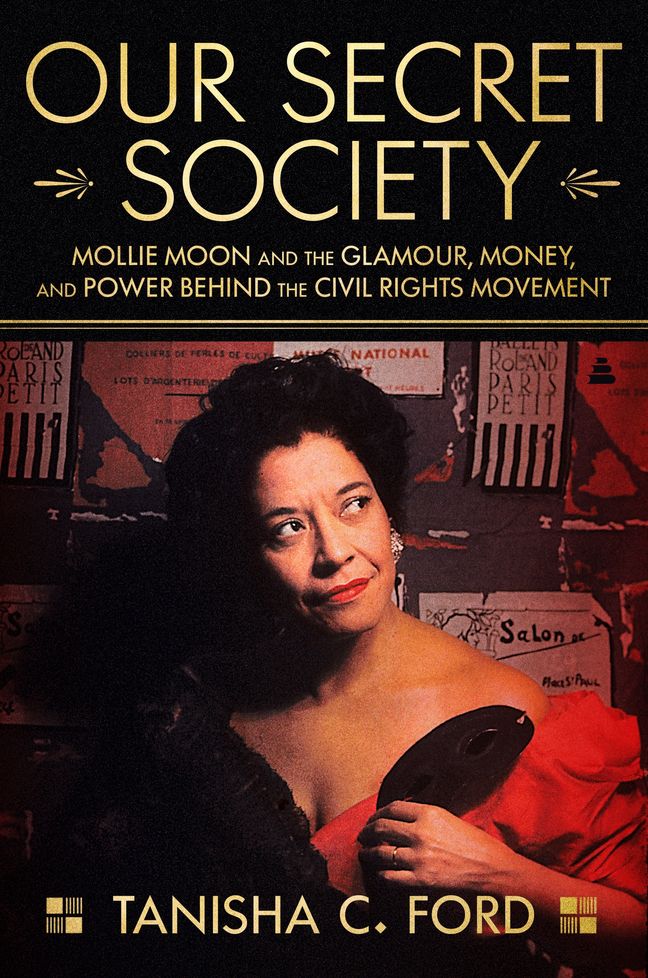
2023 | Our Secret Society: Mollie Moon and the Glamour, Money and Power Behind the Civil Rights Movement
By Dr. Tanisha C. Ford
Amistad
Press Release: Our Secret Society
Our Secret Society lifts up the central role of African-American Women in the Civil Rights Movement by tracing the life of Mollie Moon, founder and president of the National Urban League Guild, and her fundraising efforts for activists throughout the Civil Rights Movement.
“It’s important to talk about the big names in the Civil Rights Movement, but what really made the civil rights movement work were the people that you don’t hear about a lot,” said Dr. Terrence Tucker, Chair and professor of English at the University of Memphis, and Chair of the Hooks InstituteNational Book Award Committee. Tucker added, “Something else that we don’t think about is money and how the movement was paid for. Thinking about someone like Mollie Moon and the money she raised through the National Urban League, the parties she had, the types of people she interacted with, and the role that her fundraising events played not only in raising funds for the Civil Rights Movement, but also in connecting people like the Rockefellers with African American activists.”
Our Secret Society won the 2024 NAACP Image Award for Outstanding Work of Biography/Autobiography.

2022 | Black Patience: Performance, Civil Rights, and the Unfinished Project of Emancipation
By Dr. Julius B. Fleming, Jr.
New York University Press
Freedom, Now! This rallying cry became the most iconic phrase of the Civil Rights Movement, challenging the persistent command that Black people wait—in the holds of slave ships and on auction blocks, in segregated bus stops and schoolyards—for their long-deferred liberation.
In Black Patience, Julius B. Fleming Jr. argues that during the Civil Rights Movement, Black artists and activists used theater to energize this radical refusal to wait. Participating in a vibrant culture of embodied political performance that ranged from marches and sit-ins to jail-ins and speeches, these artists turned to theater to unsettle a violent racial project that Fleming refers to as “Black patience.” Inviting the likes of James Baldwin, Lorraine Hansberry, Alice Childress, Douglas Turner Ward, Duke Ellington, and Oscar Brown Jr. to the stage, “Black Patience” illuminates how Black artists and activists of the Civil Rights era used theater to expose, critique and repurpose structures of white supremacy.
 2021 | Soul City: Race, Equality and the Lost Dream of an American Utopia
By Thomas Healy, Esq.
Metropolitan Books
In 1969, with America’s cities in turmoil and racial tensions high, civil rights leader Floyd McKissick announced an audacious plan: he would build a new city in rural North Carolina, open to all but intended primarily to benefit Black people. Named Soul City, the community secured funding from the Nixon administration, planning help from Harvard and the University of North Carolina, and endorsements from the New York Times and the Today show. Before long, the brand-new settlement – built on a former slave plantation – had roads, houses, a health care center, and an industrial plant. By the year 2000, projections said, Soul City would have fifty thousand residents.
But the utopian vision was not to be. Battered from the left and the right, Soul City was shut down after just a decade. Was it an impossible dream from the beginning? Or a brilliant idea thwarted by prejudice and ignorance? And how might America be different today if Soul City had been allowed to succeed?
 2020 | Franchise: The Golden Arches in Black America
By Marcia Chatelain
Liveright Publishing/W.W. Norton
Press Release: Franchise
Franchise investigates the untold history of the cooperation among fast-food companies, politicians, civil rights leaders and black entrepreneurs in the years following the 1960s civil rights movement. This untold history looks at how the prevalence of fast-food restaurants in Black communities today resulted from a push by these groups for what they saw as an economical solution to racial disparities in America's Black communities — the franchising of fast-food restaurants in black neighborhoods by Black people. “Franchise” illuminates the power of Black-owned franchises in a larger freedom struggle while also explaining how corporations such as McDonald's have deprived genuine wealth in Black urban communities.
 2019 | Occupied Territory: Policing Black Chicago from Red Summer to Black Power
By Dr. Simon Balto
University of North Carolina Press
Press Release: Occupied Territory
Occupied Territory: Policing Black Chicago from Red Summer to Black Power, is a powerful work of history that speaks directly to our current crisis over race and policing. Occupied Territory is meticulous and engaging with conclusions that are provocative and convincing. It informs a national conversation about the racist foundations of the criminal justice system. Balto chronicles how, since the Great Migration of African Americans to northern cities such as Chicago, policing served as a brutal form of racial discipline. Despite the protests of Black Chicagoans, those practices continued over the course of the twentieth century.
 2018 | An American Odyssey: The Life and Work of Romare Bearden
By Dr. Mary Schmidt Campbell
Oxford University Press
Press Release: An American Odyssey
An American Odyssey provides a telling biography of the artist Romare Bearden, whose iconic collages conveyed the richness and complexity of African American life in the civil rights era. As Campbell demonstrates, Bearden’s work transcended the visual stereotypes of African Americans. He situated his characters in a deep past, while employing a modernist style that was re-envisioning the black experience.
 2017 | Locking Up Our Own: Crime and Punishment in Black America
By James Forman, Jr.
Farrar, Straus and Giroux Publishers
Press Release: Locking Up Our Own
In his remarkable book, Forman argues that the disproportionate impact of long prison sentences on African American communities was not shaped solely by whites, but in part by the exasperation of some African Americans who urgently demanded action to deescalate crime in their communities related to drugs. Forman encourages a candid examination of the forces that created draconian criminal sentences related to drugs to encourage honest and transformative reform of the criminal justice system.
2016 | We Are an African People: Independent Education, Black Power, and the Radical Imagination
 By Russell Rickford
Oxford University Press
Press Release: We Are an African People
In the midst of the more well-studied educational changes of the school desegregation era, a handful of "Pan African nationalist" independent black schools emerged as an alternative mechanism for African-American uplift. We Are an African People examines the ideas and motivations behind these autonomous black institutions and places them within a broader discussion about how best to achieve liberation for the next generation of African Americans. Rickford's work expands upon the understanding of a very specific topic within the quest for the intellectual liberation of African-Americans and grapples with very broad questions about education, freedom and the diversity of viewpoints during the civil rights era.
2015 | Eye On the Struggle: Ethel Payne, the First Lady of the Black Press
 By James McGrath Morris
Amistad/Harper Collins Publishers
Press Release: Eye On the Struggle
Morris' biography excavates the story of Ethel Payne, a journalist whose work for the Chicago Defender during her multi-decade career provided a lens to thousands of African-American readers into the action of the civil rights movement and beyond. Covering the school desegregation crisis in Little Rock, interviewing black troops in Vietnam or quizzing multiple presidents during her years at the White House, Payne's career demonstrated the role journalists could play both in helping to build a movement by informing the public and in furthering that movement by putting pointed questions to those in power.
2014 | Stokely: A Life
 By Peniel E. Joseph
Basic Civitas Books
Press Release: Stokely: A Life
In the 1960s, Civil Rights activist Stokely Carmichael coined the phrase "Black Power"
with the symbolic image of the raised black fist to embody it. A charismatic, forceful,
young and brilliant intellectual with civil rights rooted in non-violent tactics,
Carmichael became increasingly dissatisfied with racial inequality. This led him to
more militant approaches to achieve political self-determination for African Americans.
The book, Stokely: A Life, winner of the 2014 Benjamin L. Hooks Institute National Book Award, provides an
illuminating profile of Carmichael's journey of disappointments, conflict, and hope
for a more just nation and world.
2013 | How it Feels to be Free: Black Women Entertainers and the Civil Rights Movement

by Ruth Feldstein
Oxford University Press
Press Release: How it Feels to be Free
2013 | On the Corner: African American Intellectuals and the Urban Crisis

by Daniel Matlin
Harvard University Press
Press Release: On the Corner
On the Corner revisits the volatile moment when African American intellectuals were thrust into the spotlight as indigenous interpreters of black urban life to white America, and examines how three figures--Kenneth B. Clark, Amiri Baraka, and Romare Bearden--wrestled with the opportunities and dilemmas their heightened public statures entailed. Daniel Matlin locates in the 1960s a new dynamic that has continued to shape African American intellectual practice to the present day, as black urban communities became the chief objects of black intellectuals' perceived social obligations.
2012 | The Black Revolution on Campus
 by Martha Biondi
University of California Press
Press Release: The Black Revolution on Campus
The Black Revolution on Campus is the definitive account of an extraordinary but forgotten chapter of the black freedom struggle. In the late 1960s and early 1970s, Black students organized hundreds of protests that sparked a period of crackdown, negotiation, and reform that profoundly transformed college life. At stake was the very mission of higher education. Black students demanded that public universities serve their communities; that private universities rethink the mission of elite education; and that black colleges embrace self-determination and resist the threat of integration. Most crucially, black students demanded a role in the definition of scholarly knowledge.
2011 | Malcolm X: A Life of Reinvention

by Manning Marable
Viking
Press Release: Malcolm X: A Life of Reinvention
Manning Marable's acclaimed biography of Malcolm X finally does justice to one of the most influential and controversial figures of twentieth-century American history. Filled with startling new information and shocking revelations, Malcolm X unfolds a sweeping story of race and class in America. Reaching into Malcolm's troubled youth, it traces a path from his parents' activism as followers of Marcus Garvey through his own work with the Nation of Islam and rise in the world of black nationalism, and culminates in the never-before-told true story of his assassination.
2010 | Hands on the Freedom Plow: Personal Accounts by Women in SNCC

by Faith S. Holsaert, Martha Prescod, Norman Noonan, Judy Richardson, Betty Garman
Robinson, Jean Smith Young, and Dorothy M. Zellner University of Illinois Press
Press Release: Hands on the Freedom Plow
In Hands on the Freedom Plow, fifty-two women--northern and southern, young and old, urban and rural, black, white, and Latina--share their courageous personal stories of working for the Student Nonviolent Coordinating Committee (SNCC) on the front lines of the Civil Rights Movement.